My first week at a church where I served as communications director, a man pulled me aside before service. I'll call him Frank. Frank said he was glad I was here, but I needed to know a few things. He was direct in the way that only comes from someone who has been attending long enough to feel genuine ownership over the place. Don't touch the 8:30 service. And don't touch the bulletin.
I could have dismissed him as an out-of-touch curmudgeon. But I thought for a second and chose not to. Because underneath the bluntness was something real. A large portion of this congregation — people who had been faithful for decades, who had given and served and shown up through every season of that church — depended on that printed piece. It was how they stayed informed, followed along, and felt connected to what was happening in their church. He wasn't being precious about paper. He was telling me something true about the people I'd been hired to serve to help give me context.
I told him I wasn't removing anything. My job was bringing clarity to what already existed, and I would do anything and use any medium to reach our community for Christ.
What does dropping the bulletin assume about your congregation?
When a fresh, young creative director decides to drop the print bulletin, it probably feels like a reasonable call. The cost of printing, the paper waste, the staff time, and the percentage of bulletins left on seats every Sunday. All of these inefficiencies are real and visible. A church app can carry the same information and reach people across the week, not just on Sunday morning. The logic holds up when you're looking at it from inside your own experience.
What it doesn't account for is the person whose experience looks nothing like yours.
The congregation member who doesn't own a smartphone, or owns one and doesn't trust it, or is managing enough on a Sunday morning that pulling out a phone to find a digital guide adds friction that actually disconnects them from worship. The older member for whom that printed piece is the primary way they stay connected to what their church is doing through the week. The first-time guest who is already navigating an unfamiliar environment and finds genuine comfort in having something physical to hold. These people don't show up in the church app analytics. They don't post in the comms Facebook group, arguing that print is dead and to drop the paper bulletin. You find out it mattered to them after it's already gone.
The decision to go all-digital isn't inherently wrong. For some churches, in some seasons, with the right transition plan, it's the right call. But when it gets made without accounting for the full range of people you serve, it's not a communications strategy. It's a preference.
What goes wrong when you only serve one group?
There are two ways a church can get this wrong, and they're mirror images of each other.
The first is what happens when a communications strategy only speaks to the people who are already there and already comfortable. When every decision defaults to what the long-tenured members prefer, the church stops being able to reach anyone outside its current walls. The format never evolves, the language never changes, and the church gradually becomes a community that exists primarily to serve itself. It loses the urgency of its mission because it has stopped asking who else needs to be reached. A church that only maintains what it has is not a church that grows.
The second failure is the one Frank was warning me about. When a communications strategy only speaks to the young, the digitally fluent, and the people in the same life stage as the person making the decisions, the church quietly loses something it can't easily get back. The older voices of faith. The people who have walked with God through decades of life that younger members haven't yet even dreamed of. The intergenerational texture that makes a church different from every other gathering of people with the same demographics and the same preferences.
There's also an assumption worth challenging here. The creative instinct to go all-digital often comes from a fear that print makes the church look irrelevant to the outside world. If everyone else is digital, a piece of paper feels like falling behind. But that assumption deserves scrutiny. Gen Z is leading a broad pushback against the subscription economy and the relentless digital-everything pace of modern life. Print book sales are at a record high, and younger adults now make up the largest group of library users in the country. Your average first-time guest isn't necessarily put off by a printed piece in their hand. They may have spent the entire drive to church scrolling through a phone, fielding notifications, and managing the low-grade noise of a fully digital life. A piece of paper might be the least friction they encounter all week.
The goal is not to choose between reaching new people and honoring the people already there. It's to build a strategy that holds both, which means making decisions that account for the full range of people you serve, and the people you're hoping will walk through the door.
Free. Every Thursday.
Get articles like this in your inbox each week. Church communications strategy, practical frameworks, and honest thinking.
Subscribe FreeDoes print actually help people retain church information?
Research consistently shows that people who read on paper retain information at higher rates than those who read the same material on a screen. Screen reading tends toward skimming. Print reading tends toward deeper engagement. For a church trying to move people toward a next step, an invitation that actually gets read and retained matters.
A well-produced print bulletin, focused on doing a smaller job well, is worth the cost if your church can sustain it. Not a twelve-page document trying to carry every piece of ministry information produced that week. A clean, purposeful piece that helps someone follow the service, carries one or two high-priority items worth taking home, and goes deeper on what the church is doing than what gets said from the stage. Something worth keeping. Something that ends up tucked into a Bible, pulled out weeks later because it had a line that meant something the day it was handed over.
For younger families, a church app with smart notifications can run alongside that. For congregations with strong digital adoption, the balance tips further toward digital. The format follows the people, not the other way around.
How does a 3x3 card system work for churches?
The bulletin is not the only print tool worth thinking about. If you want a practical example of print working harder than most churches expect, consider a system built around a single format: a 3x3 card.
A 3x3 card is exactly what it sounds like. The size of a Post-it note, printed on cardstock, with one call to action on the front and an image or design that makes someone want to pick it up. One card, one ask. That's the whole rule. No paragraph of explanation, no three QR codes, no ministry contact list on the back. Just one thing, clearly said, on something small enough to slip into a pocket or a purse.
The distribution system is what makes it work. Place card holders throughout your building, positioned with intention. A holder near the main entrance carries first steps information and new guest resources. Stations near the coffee area carry ministry-specific invitations. Holders near the kids check-in area carry children's ministry content. Your belong hub or connection area carries next steps for people ready to go deeper. Each station serves the person most likely to be standing there, not the general population of everyone who walks through the door.
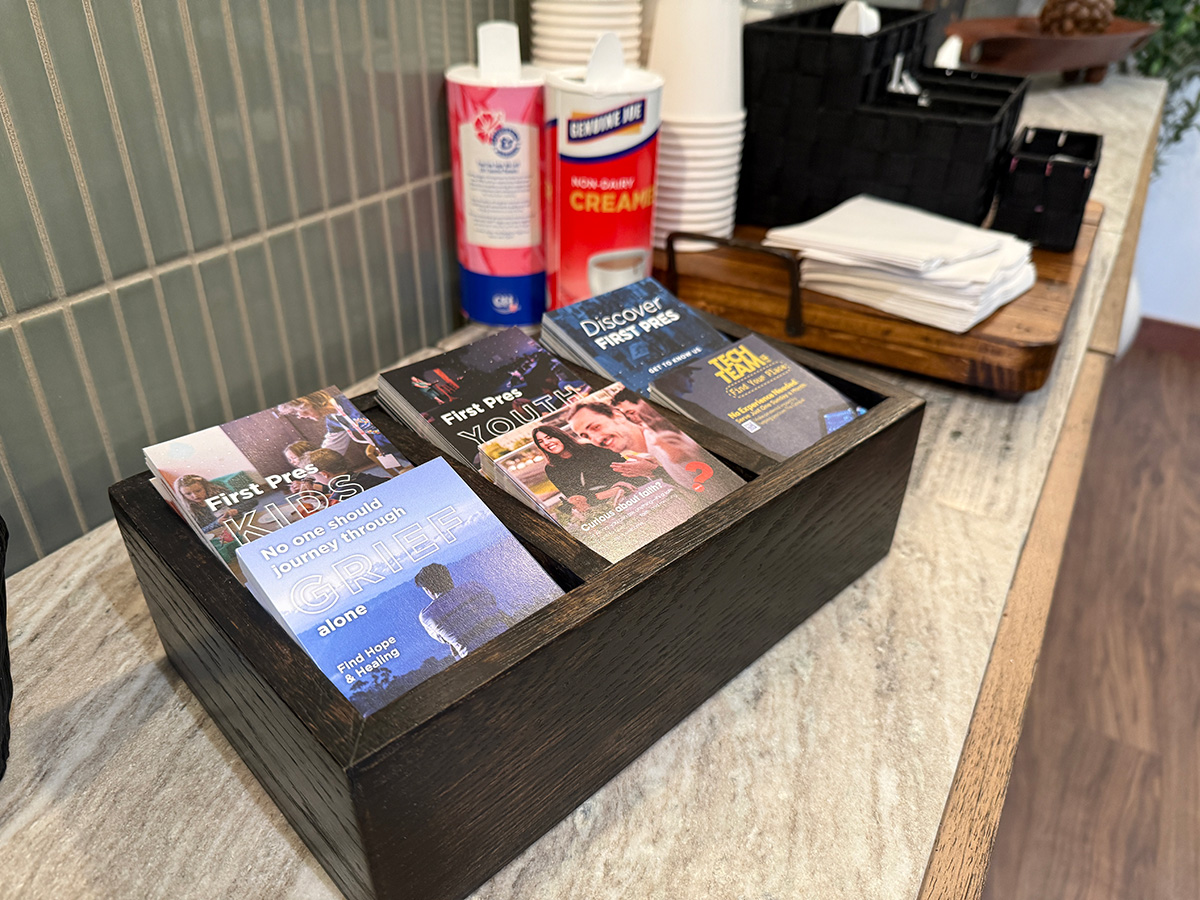

You don't need a custom woodworking setup to build this. Post-it note holders are the same footprint and widely available. Attach a few together, mount them to a wall or set them on a counter, and you have a station. If your church has an in-house print shop, the per-unit cost is minimal. If not, 3x3 cards can be printed affordably through any local or online printer.
The stations also give you something most print systems don't: passive traffic data. Check each station twice a week, after Sunday and after Wednesday service. Note what's gone and what isn't. A station that empties fast is telling you something about what that part of your congregation is responding to. A station that sits untouched is telling you something too. You don't need a dashboard to read it.
This system also solves a problem most communications directors know well. Well-meaning ministry leaders leave mismatched trifolds and half-sheet flyers scattered around the building, each one a different size, a different design, a different voice. It looks chaotic and communicates that nobody is paying attention to the overall experience. A standardized card system gives every ministry a format they can work within, keeps the building looking coherent, and puts the right information in the right place for the right person. That's not a small thing. That's communications strategy working the way it's supposed to.
Here are three example cards from a working church communications system:
Download the 3x3 Card System Blueprint
The full card holder blueprint and cut sheet, ready for your print shop. Plus three example cards from a working church communications system.
Get the BlueprintWho are you actually designing your communications for?
Every communications decision a church's communications and creative team makes reveals something about who it actually has in mind when it creates. Most of us naturally imagine the people who look like us, worship like us, and are navigating the same season of life we're in. It's just where our imagination starts, but we have to be wary of thinking outside of what's familiar to be servants.
A church that only speaks to the people it already understands well gradually becomes a church that only has those people in its midst. It doesn't happen in one dramatic moment, but in a hundred small decisions, each one made with the best intentions, each one slowly narrowing the variety of folks in your sphere.
The church was never meant to be a cruise ship, comfortable and self-contained, sailing in circles for the people already on board. It's easy to dream of sipping fruity drinks with umbrellas while lounging on the deck. Our church should be a different kind of vessel entirely, pointed outward, carrying every generation toward something bigger than any one of them could reach alone. The faith of someone who has been walking with God for more than fifty years doesn't need to be quietly ignored in the background of a healthy church. That faithfulness is part of what shapes what the church believes is possible, and that faithfulness is what stands the weathering age of the sinful world outside our doors because it shares wisdom.
Frank wasn't a curmudgeon protecting his preferences. He was a faithful man, telling me that his generation was still here, still showing up, still part of what makes that church what it is. He needed to know I saw them and not just the young people in our community. That I wasn't going to build a communications strategy that left them behind.
I wasn't. And neither should you.